
Today we talk about liability forecasting and the role it plays in the administration of massive, sometimes multi-billion-dollar mass tort settlement trusts. These mechanisms were built to fairly and judiciously compensate current and future claimants for their injuries.
Mass tort litigation is a complicated beast, as is the administration of these trusts.
- Exposures, injuries, and the discovery of injuries can occur over decades. In the meantime, companies come and go. They are bought and sold. They declare bankruptcy.
- People are exposed to new elements or conditions in the environment and the workplace.
- On the financial side, market fluctuations and interest rates impact the value of the funds.
- On the medical side, advancements in diagnostics can affect the number of claimants and the timing of their claims.
- New technologies can be a factor, too, like the ability to create deep-fake evidence or even claimants.
- Then there are the unpredictable events. The Covid-19 pandemic offered another confounding factor when many Americans suddenly had virus-related respiratory issues, perhaps joining injuries they may have suffered or were quietly developing, from a toxic exposure.
In other words, there are many overlapping, interlocking, intersecting, and dynamic layers involved with people, companies, diseases, certain financial externalities, and “black swans” that complicate the oversight of settlement funds.
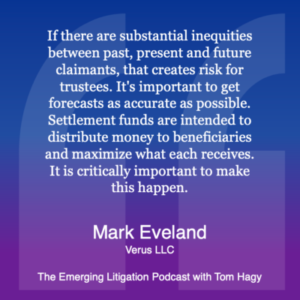
Listen to my conversation with Mark Eveland and Ed Silverman, both with Verus LLC, which provides litigation support services to law firms working on mass torts, such as case management and medical review services, settlement administration, business and advisory services, and analytics. They explain that liability forecasting is a practice best understood through the three areas it analyzes: (i) the risks and injuries created by a product and its use, (ii) claims filed and approved, and (iii) finances. Liability forecasting is both a science and an art, they say, with plenty of risks.
 Eveland, founder, CSO, and chairman of the board, is an expert in building settlement and claims management programs for mass torts, class actions, and insurance runoffs. Throughout his career, Mark has provided research, discovery, analytics, settlement administration, and expert witness support to litigators around the country.
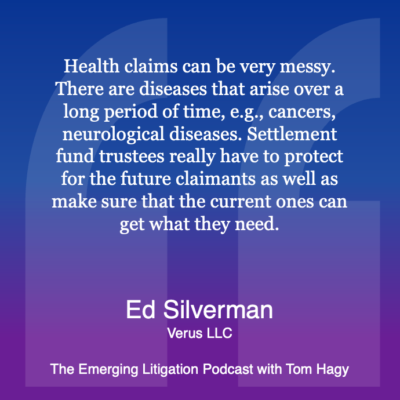
Trained in molecular biology, genetics and epigenetics, and biochemistry, Silverman is an analytics executive, a life science expert, and a biomedical communications specialist. Ed assists with data analytics, scientific collaboration networks, patient-based medical claims, and more.
Thanks for listening!
If you like what you hear, please give us a rating. You’d be amazed at how much that helps.
If you have questions for Tom or would like to participate, you can reach him at Editor@LitigationConferences.com.
Ask him about creating this kind of content for your firm — podcasts, webinars, blogs, articles, papers, and more.
Tom Hagy
Litigation Enthusiast and
Host of the Emerging Litigation Podcast
LinkedIn
Bonus: I left in a little introductory jazz in the beginning, then encouraged Ed to discuss his background and research, which I was thrilled to find included how fruit flies (Drosophila melanogaster) form memories. I can’t tell you how glad I was that I asked. Yes, I can. Very glad.
Watch This Podcast Now
FILED UNDER: Mass Torts & Class Actions
TAGS: Bankruptcy | Claims Management | Data Analytics | Settlements | Toxic Torts
Our Guests

Your Host